
Pat Farenga's Blog

Homeschooling and Family Culture
In the face of worldwide declining births, shouldn’t we be thinking about ways to structure society so it makes having children desirable? The surprising increase of homeschooled children in recent years is also an indicator that more parents want something that society is not providing: not more time in school, but more family time.

Reimagining Education Beyond Traditional Boundaries
John Holt: “I have met some fine teachers who have told me that for as long as twenty years or more they have been working in this or that school or system to bring about some of the kinds of changes I am urging, and with no success at all. I can admire their courage but not their tactical judgment. Not only have they wasted their time, skill, and devotion; they have given them to an institution that has made bad use of them.”

Rethinking “Schlepping Children Around”
All of those complaints are valid, and I’m certainly someone who, with four children, does a lot of driving to activities in the course of a week. We’re all really happy with those activities that the children are involved in, but it certainly does involve a lot of car time. Lately, though, I’ve been thinking about that car time, and about the positive side of it.

What Do I Do Monday?
Of my own seven books, perhaps the most immediately useful to unschoolers may be What Do I Do Monday? It suggests many specific ways in which children can explore the world (in writing, math, science, etc.), and learn and feel its wholeness and interconnectedness.—John Holt

“You Don’t Go To School?”
“Are your parents teachers?” “Do you have any friends?” and on and on. It’s come to the point where I feel like saying, “It’s really none of your business.” I don’t say that, of course. …

Recovering Enthusiasm, Self-Esteem
From the beginning Benjamin (now 14) has marched to another drummer. He did not read with any success until he was 9 …

John Holt's Last Speech About Homeschooling
John Holt sometimes used his Sony Walkman cassette recorder to tape his public talks, and this one, on April 29, 1985, turned out to be his last. The sound quality deteriorated a lot on this tape, so I had it remastered successfully and I hope you enjoy the audio. John was dealing with cancer during this talk and he died on Sept. 14, 1985. Nonetheless, John continued to share and explain his ideas about education in an amiable manner at this event, enjoying his interactions with the children and adults, and making some off-hand comments about Shakespeare and other educational topics that will infuriate some and tickle others.

Homeschooling On A Farm
Most educators would not recommend learning how to care for farm animals, raise food, mend fences, and so on as a well-rounded education. Nonetheless, this is not an uncommon theme in the pages of Growing Without Schooling magazine.
Helping Children Grow Into Peaceful Adults
The fundamental educational problem of our time is to find ways to help children grow into adults who have no wish to do harm. We must recognize that traditional education, far from having ever solved this problem, has never tried to solve it. Indeed, its efforts have, if anything, been in exactly the opposite direction …

How Unschooling Can Work For You
A recent article in the UK Guardian cites successful unschoolers, but the overall tone is that children are being harmed or neglected because of unschooling. Unschooling isn’t just about leaving your child alone to figure things out, as these stories show.

Why Schools Don’t Nurture Einsteins, According to Albert Einstein
As school starts for millions of children around the world those who prefer to help their children learn at home and in their communities, or in alternative schools, can find solace in Albert Einstein’s summation of modern education.

Let Children Own Their Learning Moments
Too often parents and teachers want to let children know they approve of what the child is doing, and by doing so they ruin the “learning moment” for the child. Keeping our egos out of our children’s learning is hard to do, but worth doing, as it can help children develop a stronger sense of self, as these letters show.
Students Grade U.S. Schools in Gallup Poll
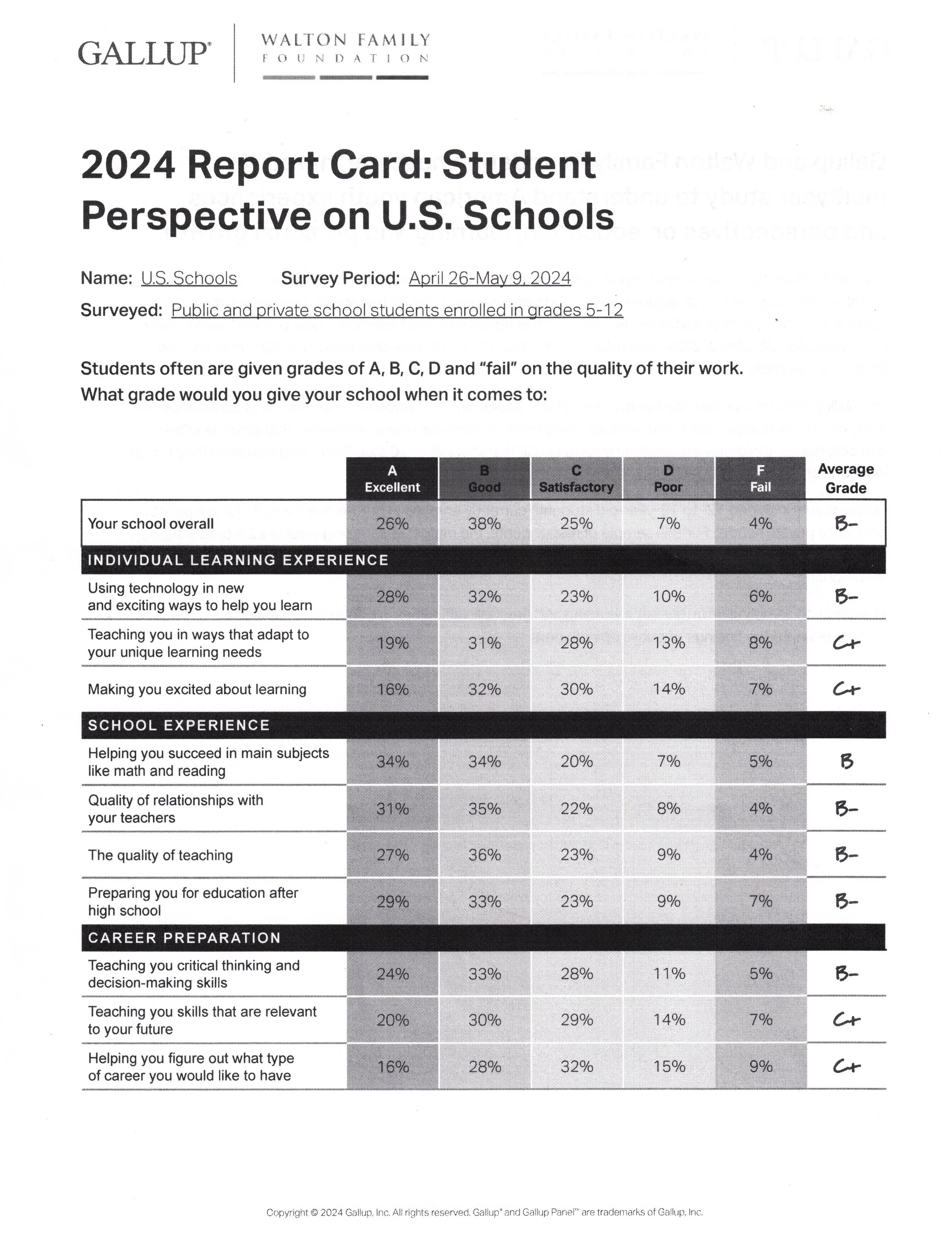
Students give U.S. schools middling to poor grades, and the majority of parents are dissatisfied with their schools. Yet school continues to offer its one-size-fits-all approach as the way to fix things.
Whose Fault?
Supporting a child’s learning takes time, observation, and empathy, all things that are lacking in most schools. This is largely due to institutional practices and schedules, but this obstacle is not necessary in one’s home, if one is attuned to their children’s natural growth rather than a planned curriculum.
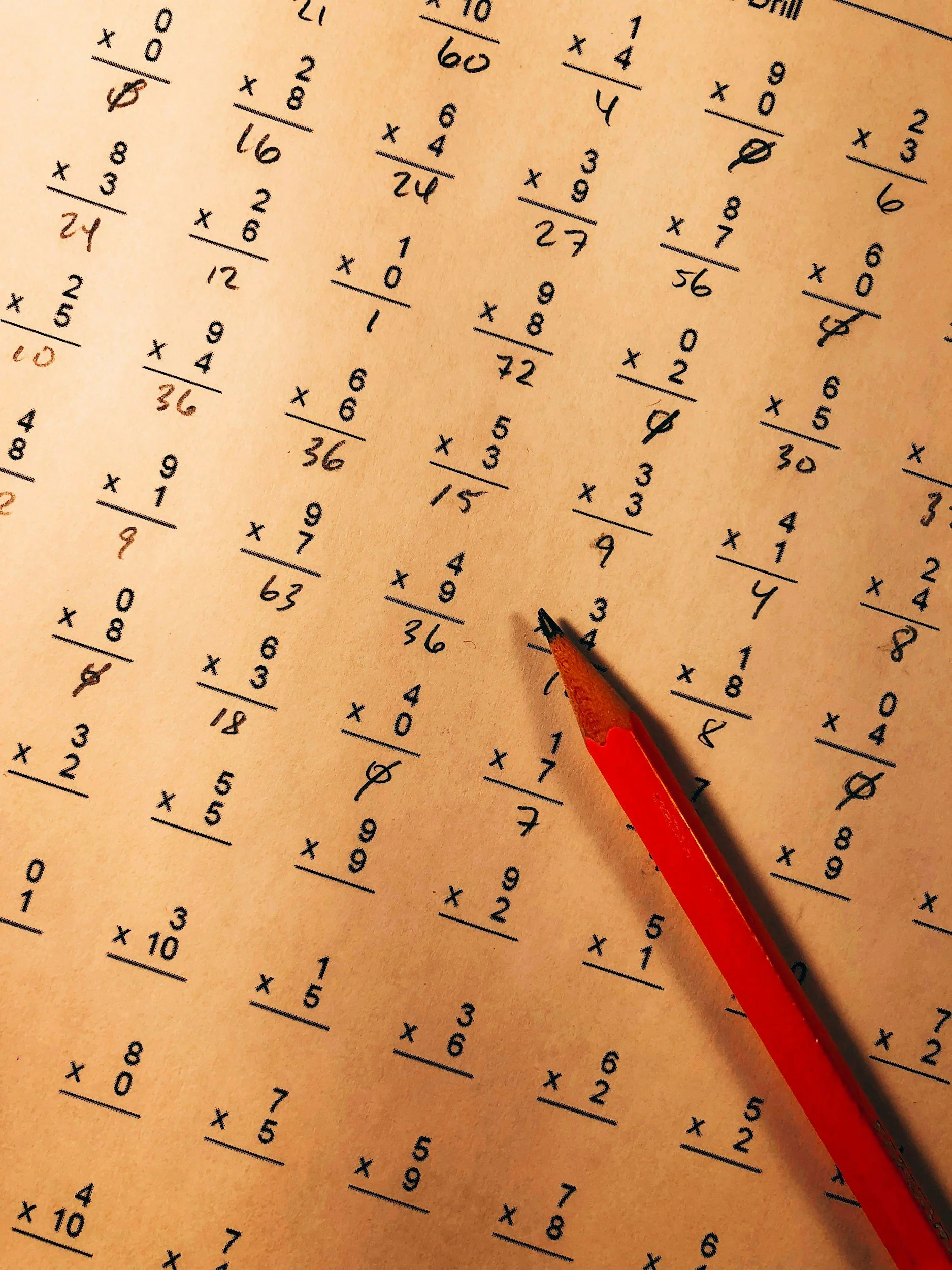
The Mathematics of the Ordinary
“The important question for me, given my view of mathematics of the ordinary, is not how it can be taught, but how it can be lived. I don’t think we need to find special “math-speaking” tutors when it comes to the mathematics of the ordinary. Most young children are not interested in becoming specialists in mathematics. But it is in their nature, indeed, in practically everyone’s nature, to wonder about the patterns and regularities they observe in the world.”—Aaron Falbel

No Formal Education? No Problem.
Lidya Foxglove writes: “I was unschooled through most of my childhood and never went to college. I’ve gotten questions and sometimes pushback about it all my life but I think it helped me to my writing career as well as living intentionally.”

How Can Children Know What They Need To Learn?
John Holt: “I have always said, but never with an example as eloquent and persuasive as this, that though the child may not know what he may need to know in ten years, he knows, and much better than anyone else, what he wants and needs to know next, in short, what his mind is ready and hungry for.”

What Is Deschooling About?
Before the words homeschooling and unschooling existed, the word “deschooling” filled their space. What is that all about?

